#유용, 표준전과, 'Claude Code(클로드 코드)' 시작하기 & 핵심 정리
표준전과, AI 코딩 도구 'Claude Code(클로드 코드)' 시작하기 & 핵심 정리
Anthropic에서 선보인 CLI 기반 AI 코딩 보조 도구 Claude Code에 대해 알고 계신가요? 개발자가 터미널을 떠나지 않고도 코드 분석, 리팩토링, 버그 수정, Git 커밋까지 자연어로 지시할 수 있는 혁신적인 도구입니다. 공식 문서를 바탕으로 한 핵심 가이드와 설치법을 빠르게 정리해 드립니다.
1 Claude Code란 무엇인가요?
Claude Code는 기존 IDE(VS Code, Cursor 등) 확장 프로그램 방식과 달리, 터미널(CLI) 환경에서 직접 동작하는 Agentic AI 코딩 에이전트입니다.
🚀 주요 핵심 기능
- 코드베이스 탐색 및 이해: 프로젝트 전체 아키텍처와 파일 구조를 스스로 분석하여 정밀한 답을 제공합니다.
- 자동 코드 수정 및 버그 패치: 자연어로 특정 기능 구현이나 버그 수정을 요청하면 관련 파일들을 직접 찾아 수정합니다.
- 테스트 및 CLI 명령 실행: 빌드 명령어나 테스트 코드를 직접 실행해보고 결과까지 검증합니다.
- Git 작업 자동화: 변경된 내역을 바탕으로 적절한 Git 커밋 메시지 작성, 브랜치 생성, PR(Pull Request) 작업을 지원합니다.
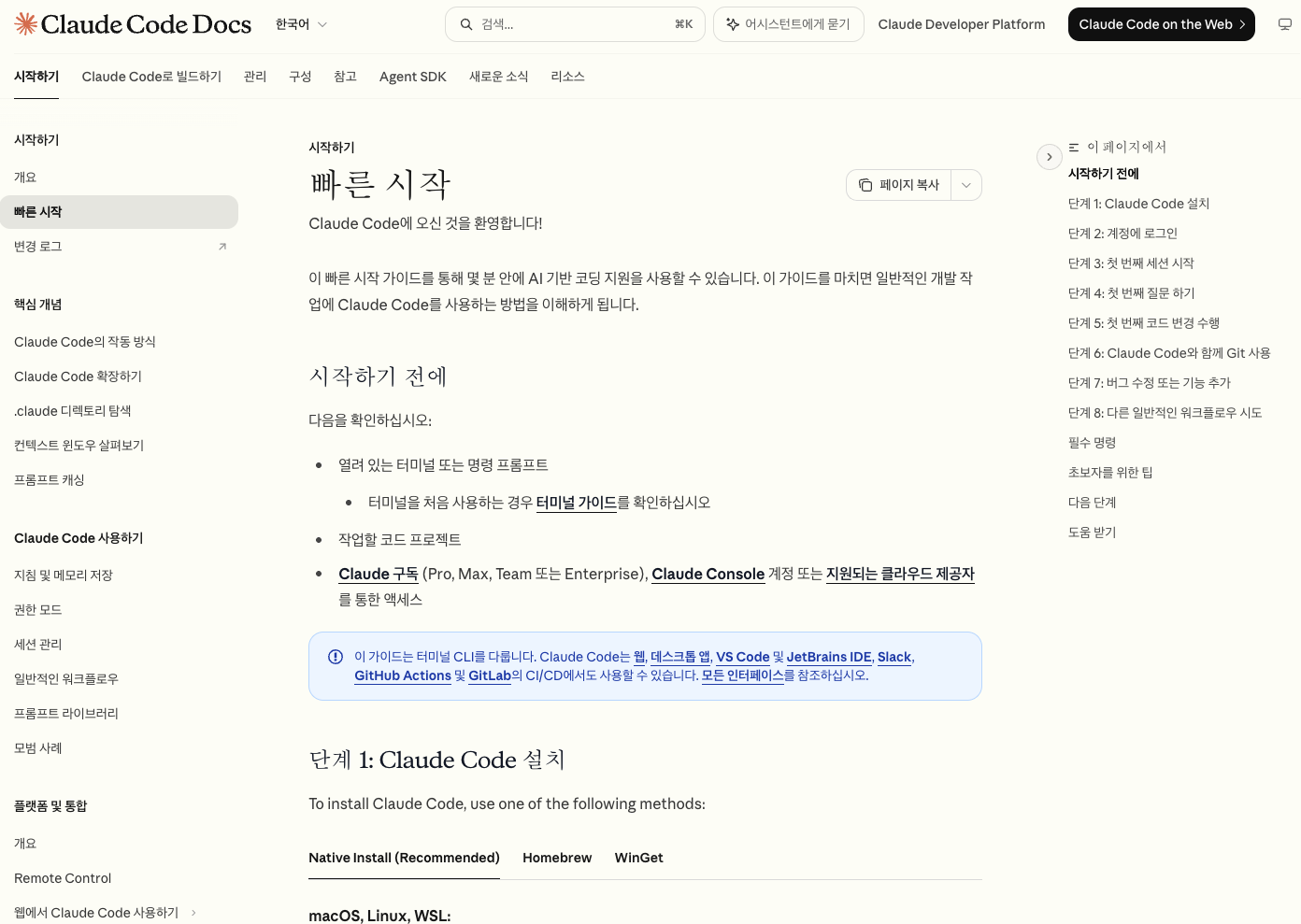
2 설치법 & 시작하기 (Quickstart)
Claude Code를 사용하기 위해서는 Node.js(18 이상) 환경과 Anthropic 계정이 필요합니다. 터미널에서 단 몇 줄의 명령어만으로 설치할 수 있습니다.
첫 실행 시 Anthropic 계정 인증 화면으로 연결되며, 웹에서 인증을 완료하면 터미널 프롬프트에서 바로 Claude와 대화를 시작할 수 있습니다.
3 실제 터미널 사용 예시 명령어
| 목적 | 프롬프트 지시 예시 |
|---|---|
| 코드베이스 분석 | "이 프로젝트의 데이터 흐름과 메인 아키텍처를 설명해줘." |
| 버그 수정 | "로그인 시 발생하는 401 오류 원인을 찾아서 고쳐줘." |
| 테스트 자동화 | "user.service.ts 파일에 대한 단위 테스트를 추가하고 실행해줘." |
| Git 커밋 및 PR | "지금 변경사항 정리해서 커밋하고 PR 작성해줘." |
💡 총평 & 가치
Claude Code는 단순한 코드 완성을 넘어, 터미널 명령 실행부터 커밋까지 개발 생산성을 극대화해 주는 강력한 AI 도구입니다. 기존에 터미널 기반 개발 흐름을 선호하시는 개발자분들이나, 빠르게 프로젝트 구조를 파악하고자 하시는 분들께 적극 추천합니다!
> ## Documentation Index
> Fetch the complete documentation index at: https://code.claude.com/docs/llms.txt
> Use this file to discover all available pages before exploring further.
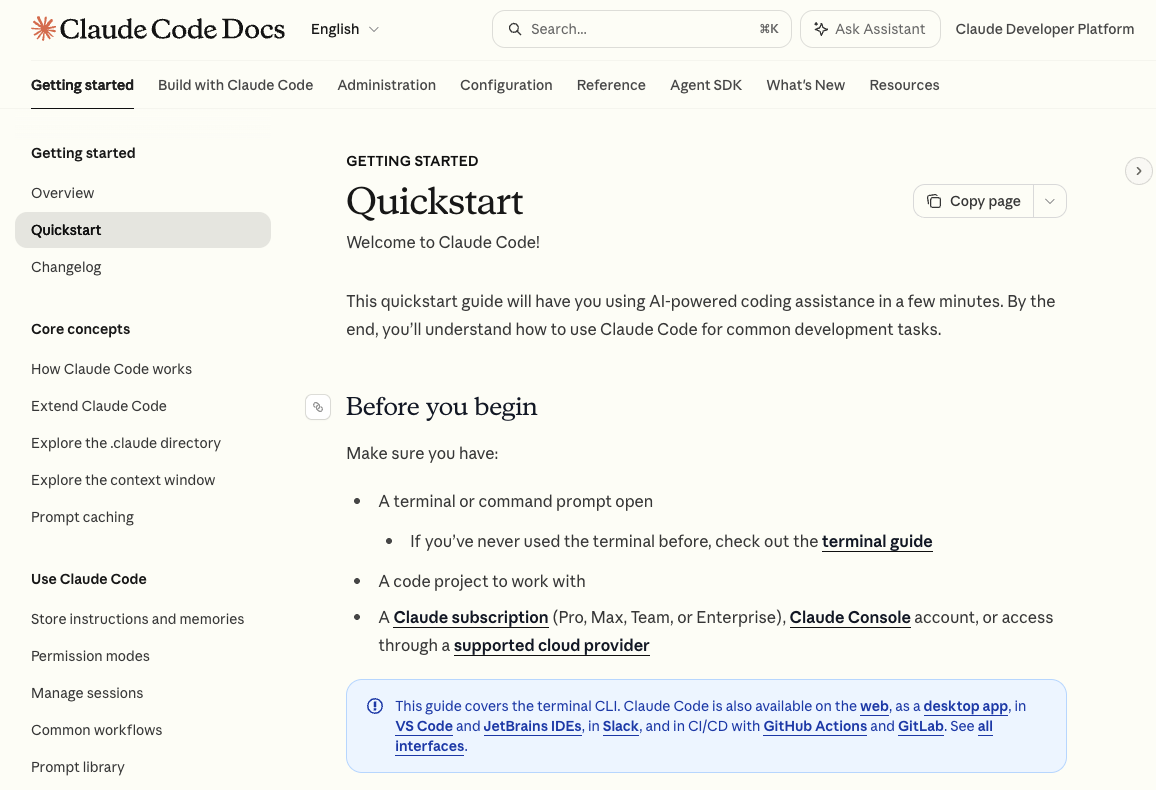
Quickstart
> Welcome to Claude Code!
This quickstart guide will have you using AI-powered coding assistance in a few minutes. By the end, you'll understand how to use Claude Code for common development tasks.
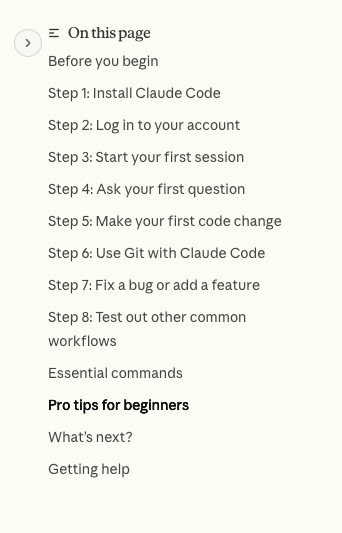
Before you begin
Make sure you have:
* A terminal or command prompt open
* If you've never used the terminal before, check out the [terminal guide](/docs/en/terminal-guide)
* A code project to work with
* A [Claude subscription](https://claude.com/pricing?utm_source=claude_code\&utm_medium=docs\&utm_content=quickstart_prereq) (Pro, Max, Team, or Enterprise), [Claude Console](https://console.anthropic.com/)) account, or access through a [supported cloud provider](/docs/en/third-party-integrations)
This guide covers the terminal CLI. Claude Code is also available on the \[web\]([https://claude.ai/code),](https://claude.ai/code),) as a \[desktop app\](/docs/en/desktop), in \[VS Code\](/docs/en/vs-code) and \[JetBrains IDEs\](/docs/en/jetbrains), in \[Slack\](/docs/en/slack), and in CI/CD with \[GitHub Actions\](/docs/en/github-actions) and \[GitLab\](/docs/en/gitlab-ci-cd). See \[all interfaces\](/docs/en/overview#use-claude-code-everywhere).
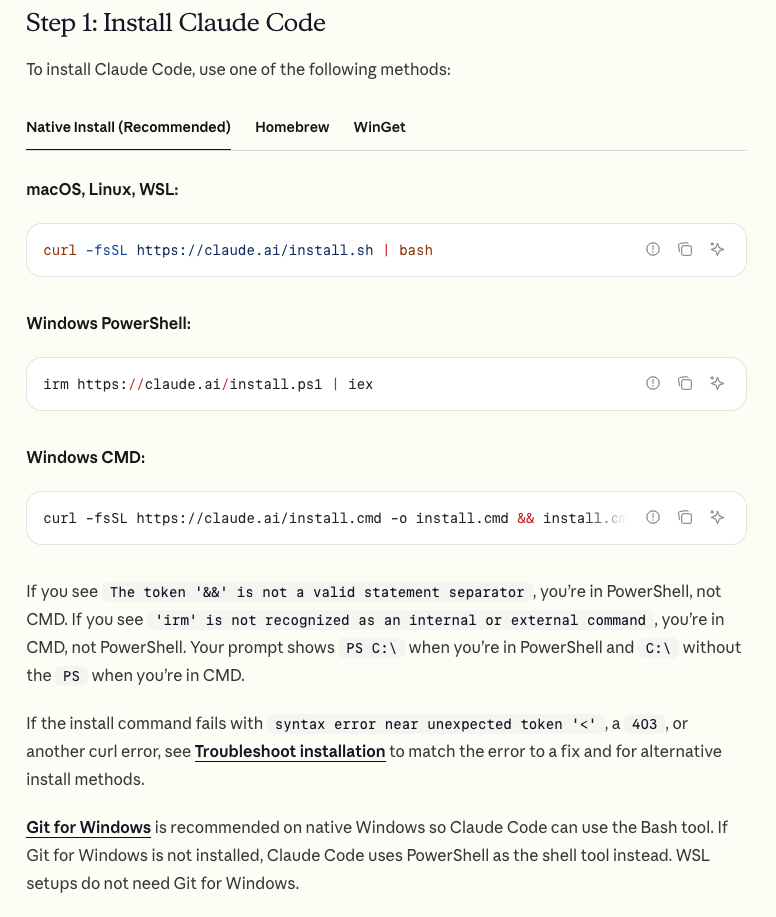
Step 1: Install Claude Code
To install Claude Code, use one of the following methods:
\*\*macOS, Linux, WSL:\*\*
\`\`\`bash theme={null}
curl -fsSL [https://claude.ai/install.sh](https://claude.ai/install.sh) | bash
\`\`\`

\*\*Windows PowerShell:\*\*

\`\`\`powershell theme={null}
irm [https://claude.ai/install.ps1](https://claude.ai/install.ps1) | iex
\`\`\`

\*\*Windows CMD:\*\*

\`\`\`batch theme={null}
curl -fsSL [https://claude.ai/install.cmd](https://claude.ai/install.cmd) -o install.cmd && install.cmd && del install.cmd
\`\`\`

If you see \`The token '&&' is not a valid statement separator\`, you're in PowerShell, not CMD. If you see \`'irm' is not recognized as an internal or external command\`, you're in CMD, not PowerShell. Your prompt shows \`PS C:\\\` when you're in PowerShell and \`C:\\\` without the \`PS\` when you're in CMD.

If the install command fails with \`syntax error near unexpected token '<'\`, a \`403\`, or another curl error, see \[Troubleshoot installation\](/docs/en/troubleshoot-install#find-your-error) to match the error to a fix and for alternative install methods.

\[Git for Windows\]([https://git-scm.com/downloads/win)](https://git-scm.com/downloads/win)) is recommended on native Windows so Claude Code can use the Bash tool. If Git for Windows is not installed, Claude Code uses PowerShell as the shell tool instead. WSL setups do not need Git for Windows.

<Info>
  Native installations automatically update in the background to keep you on the latest version.
</Info>
\`\`\`bash theme={null} brew install --cask claude-code \`\`\`
Homebrew offers two casks. \`claude-code\` tracks the stable release channel, which is typically about a week behind and skips releases with major regressions. \`claude-code@latest\` tracks the latest channel and receives new versions as soon as they ship.

<Info>
  Homebrew installations do not auto-update. Run \`brew upgrade claude-code\` or \`brew upgrade claude-code@latest\`, depending on which cask you installed, to get the latest features and security fixes.
</Info>
\`\`\`powershell theme={null} winget install Anthropic.ClaudeCode \`\`\`
<Info>
  WinGet installations do not auto-update. Run \`winget upgrade Anthropic.ClaudeCode\` periodically to get the latest features and security fixes.
</Info>
You can also install with [apt, dnf, or apk](/docs/en/setup#install-with-linux-package-managers) on Debian, Fedora, RHEL, and Alpine.
To confirm the installation worked, run:
```bash theme={null}
claude --version
```
The command prints a version number followed by `(Claude Code)`.
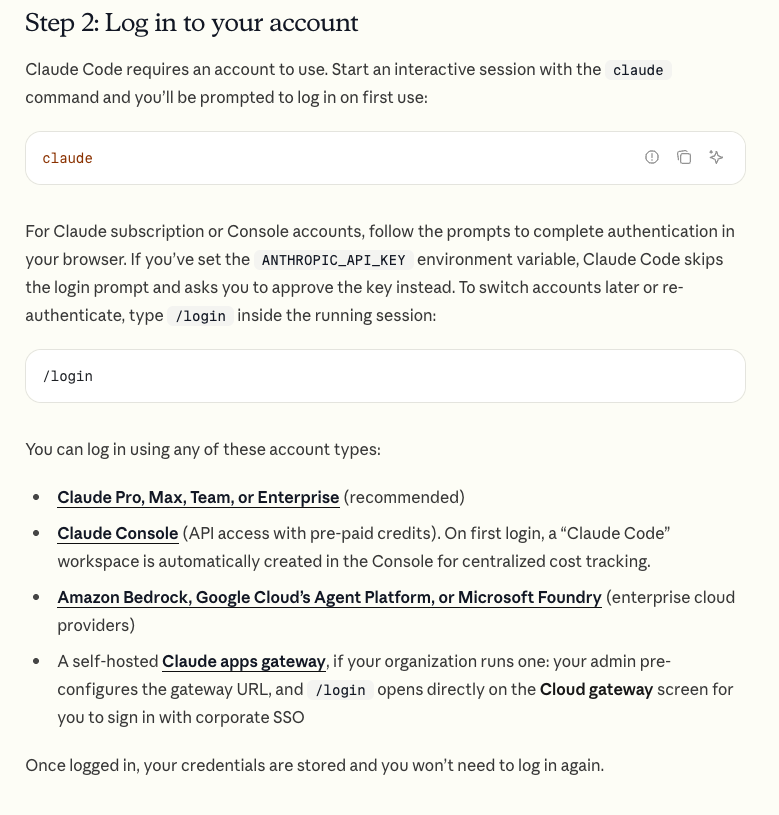
Step 2: Log in to your account
Claude Code requires an account to use. Start an interactive session with the `claude` command and you'll be prompted to log in on first use:
```bash theme={null}
claude
```
For Claude subscription or Console accounts, follow the prompts to complete authentication in your browser. If you've set the `ANTHROPIC_API_KEY` environment variable, Claude Code skips the login prompt and asks you to approve the key instead. To switch accounts later or re-authenticate, type `/login` inside the running session:
```text wrap theme={null}
/login
```
You can log in using any of these account types:
* [Claude Pro, Max, Team, or Enterprise](https://claude.com/pricing?utm_source=claude_code\&utm_medium=docs\&utm_content=quickstart_login) (recommended)
* [Claude Console](https://console.anthropic.com/)) (API access with pre-paid credits). On first login, a "Claude Code" workspace is automatically created in the Console for centralized cost tracking.
* [Amazon Bedrock, Google Cloud's Agent Platform, or Microsoft Foundry](/docs/en/third-party-integrations) (enterprise cloud providers)
* A self-hosted [Claude apps gateway](/docs/en/claude-apps-gateway), if your organization runs one: your admin pre-configures the gateway URL, and `/login` opens directly on the **Cloud gateway** screen for you to sign in with corporate SSO
Once logged in, your credentials are stored and you won't need to log in again.
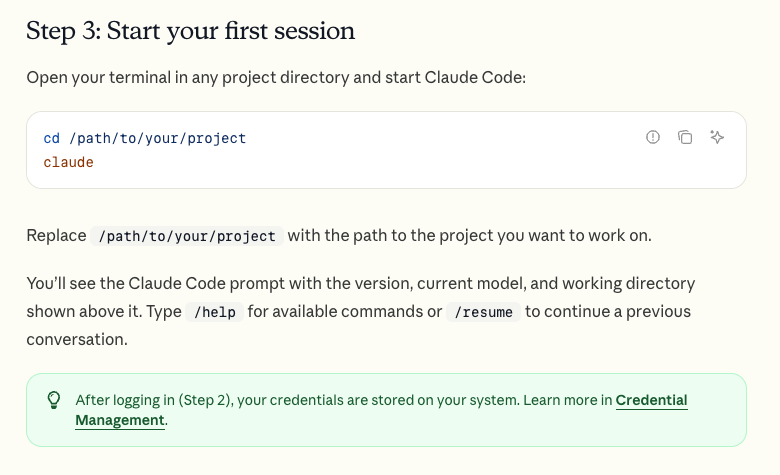
Step 3: Start your first session
Open your terminal in any project directory and start Claude Code:
```bash theme={null}
cd /path/to/your/project
claude
```
Replace `/path/to/your/project` with the path to the project you want to work on.
You'll see the Claude Code prompt with the version, current model, and working directory shown above it. Type `/help` for available commands or `/resume` to continue a previous conversation.
After logging in (Step 2), your credentials are stored on your system. Learn more in \[Credential Management\](/docs/en/authentication#credential-management).
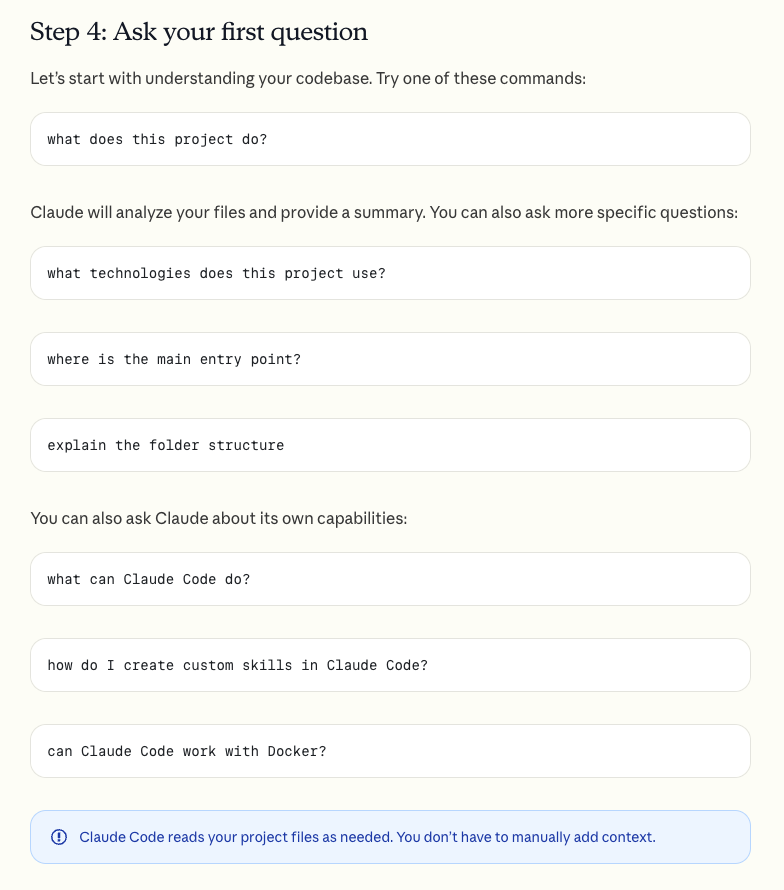
Step 4: Ask your first question
Let's start with understanding your codebase. Try one of these commands:
```text wrap theme={null}
what does this project do?
```
Claude will analyze your files and provide a summary. You can also ask more specific questions:
```text wrap theme={null}
what technologies does this project use?
```
```text wrap theme={null}
where is the main entry point?
```
```text wrap theme={null}
explain the folder structure
```
You can also ask Claude about its own capabilities:
```text wrap theme={null}
what can Claude Code do?
```
```text wrap theme={null}
how do I create custom skills in Claude Code?
```
```text wrap theme={null}
can Claude Code work with Docker?
```
Claude Code reads your project files as needed. You don't have to manually add context.
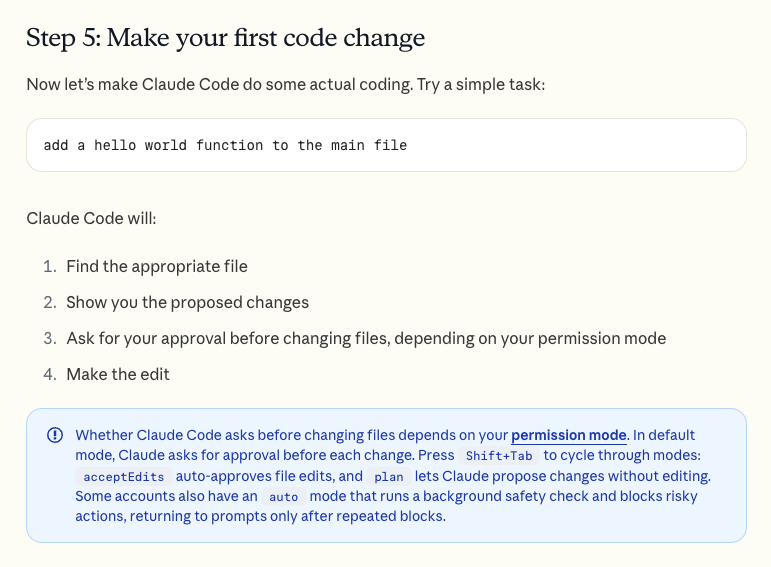
Step 5: Make your first code change
Now let's make Claude Code do some actual coding. Try a simple task:
```text wrap theme={null}
add a hello world function to the main file
```
Claude Code will:
- Find the appropriate file
- Show you the proposed changes
- Ask for your approval before changing files, depending on your permission mode
- Make the edit
Whether Claude Code asks before changing files depends on your \[permission mode\](/docs/en/permission-modes). In default mode, Claude asks for approval before each change. Press \`Shift+Tab\` to cycle through modes: \`acceptEdits\` auto-approves file edits, and \`plan\` lets Claude propose changes without editing. Some accounts also have an \`auto\` mode that runs a background safety check and blocks risky actions, returning to prompts only after repeated blocks.
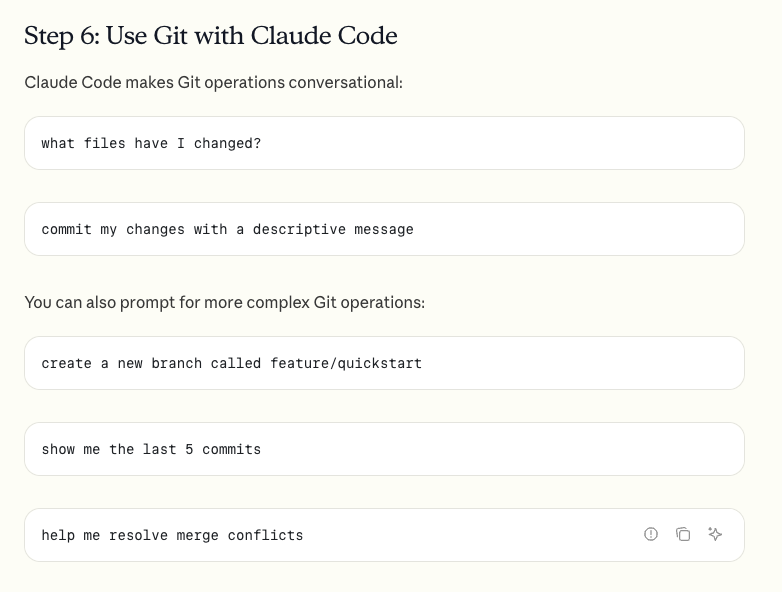
Step 6: Use Git with Claude Code
Claude Code makes Git operations conversational:
```text wrap theme={null}
what files have I changed?
```
```text wrap theme={null}
commit my changes with a descriptive message
```
You can also prompt for more complex Git operations:
```text wrap theme={null}
create a new branch called feature/quickstart
```
```text wrap theme={null}
show me the last 5 commits
```
```text wrap theme={null}
help me resolve merge conflicts
```
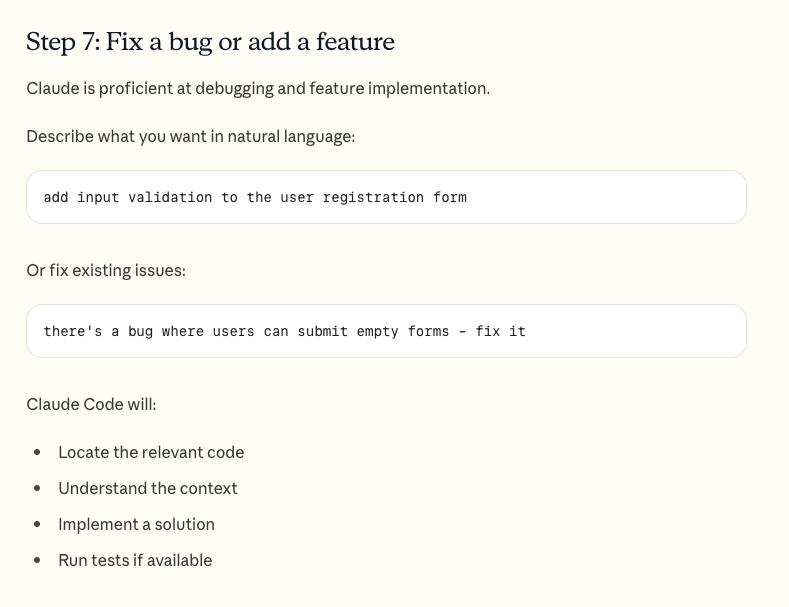
Step 7: Fix a bug or add a feature
Claude is proficient at debugging and feature implementation.
Describe what you want in natural language:
```text wrap theme={null}
add input validation to the user registration form
```
Or fix existing issues:
```text wrap theme={null}
there's a bug where users can submit empty forms - fix it
```
Claude Code will:
* Locate the relevant code
* Understand the context
* Implement a solution
* Run tests if available
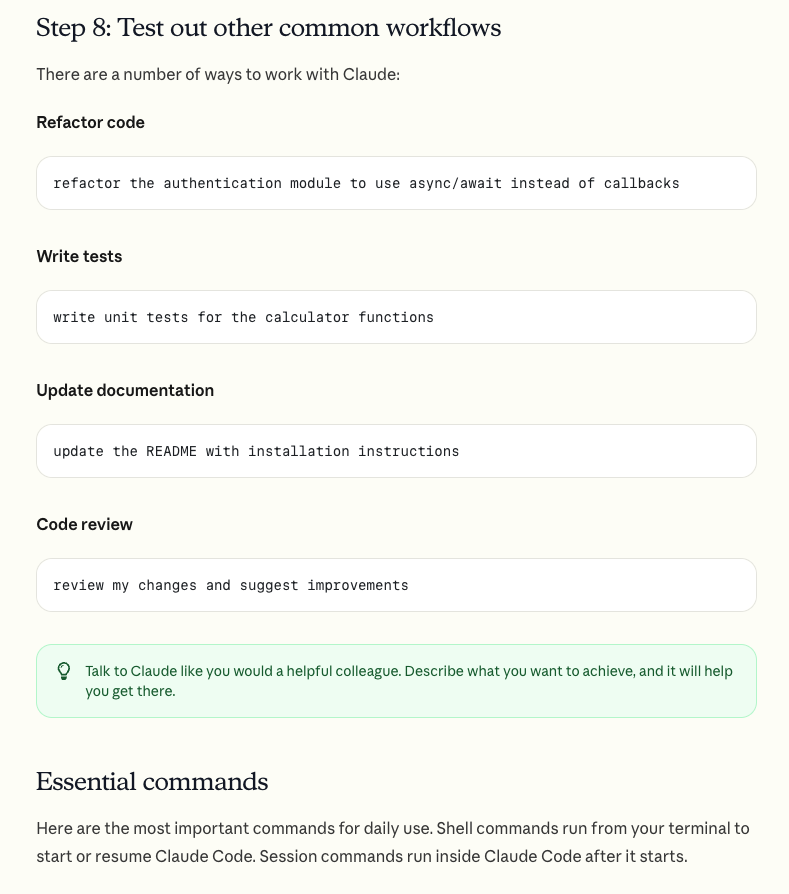
Step 8: Test out other common workflows
There are a number of ways to work with Claude:
**Refactor code**
```text wrap theme={null}
refactor the authentication module to use async/await instead of callbacks
```
**Write tests**
```text wrap theme={null}
write unit tests for the calculator functions
```
**Update documentation**
```text wrap theme={null}
update the README with installation instructions
```
**Code review**
```text wrap theme={null}
review my changes and suggest improvements
```
Talk to Claude like you would a helpful colleague. Describe what you want to achieve, and it will help you get there.
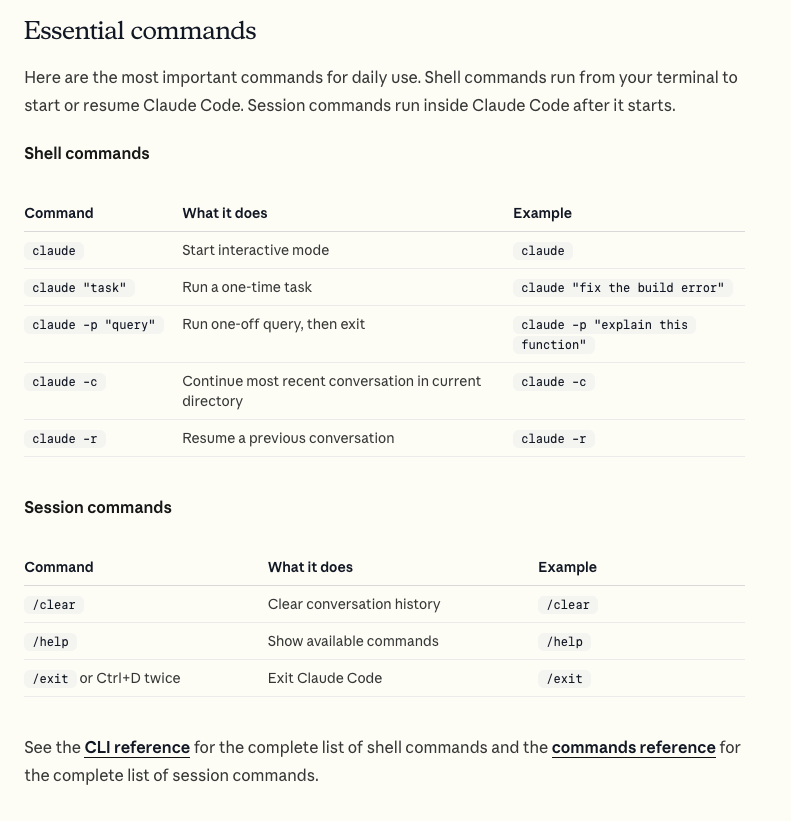
Essential commands
Here are the most important commands for daily use. Shell commands run from your terminal to start or resume Claude Code. Session commands run inside Claude Code after it starts.
**Shell commands**
| Command | What it does | Example |
|---|---|---|
| `claude` | Start interactive mode | `claude` |
| `claude "task"` | Run a one-time task | `claude "fix the build error"` |
| `claude -p "query"` | Run one-off query, then exit | `claude -p "explain this function"` |
| `claude -c` | Continue most recent conversation in current directory | `claude -c` |
| `claude -r` | Resume a previous conversation | `claude -r` |
**Session commands**
| Command | What it does | Example |
|---|---|---|
| `/clear` | Clear conversation history | `/clear` |
| `/help` | Show available commands | `/help` |
| `/exit` or Ctrl+D twice | Exit Claude Code | `/exit` |
See the [CLI reference](/docs/en/cli-reference) for the complete list of shell commands and the [commands reference](/docs/en/commands) for the complete list of session commands.
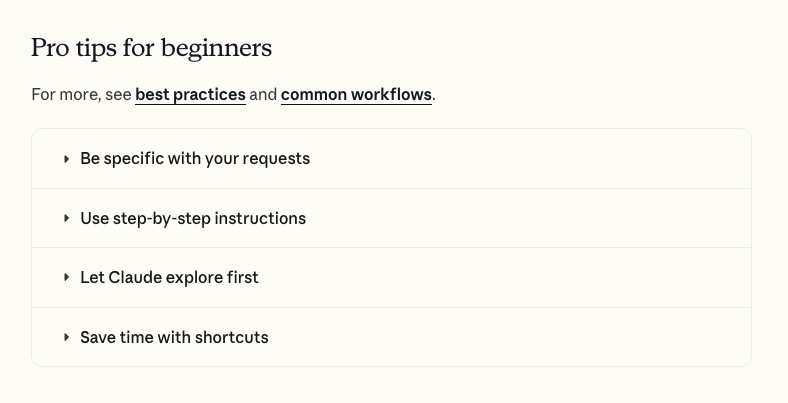
Pro tips for beginners
For more, see [best practices](/docs/en/best-practices) and [common workflows](/docs/en/common-workflows).
Instead of: "fix the bug"
Try: "fix the login bug where users see a blank screen after entering wrong credentials" Break complex tasks into steps:
\`\`\`text wrap theme={null}
1. create a new database table for user profiles
2. create an API endpoint to get and update user profiles
3. build a webpage that allows users to see and edit their information
\`\`\`
Before making changes, let Claude understand your code:
\`\`\`text wrap theme={null}
analyze the database schema
\`\`\`

\`\`\`text wrap theme={null}
build a dashboard showing products that are most frequently returned by our UK customers
\`\`\`
\* Type \`/\` to see all commands and skills \* Use Tab for command completion \* Press ↑ for command history \* Press \`Shift+Tab\` to cycle permission modes
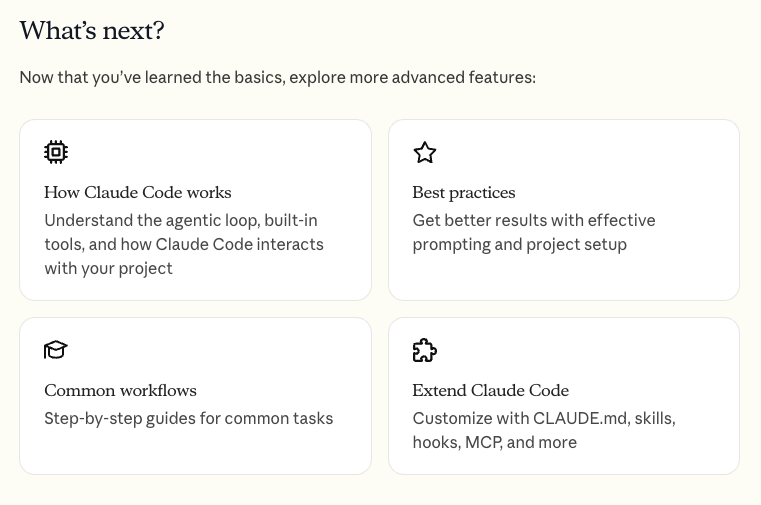
What's next?
Now that you've learned the basics, explore more advanced features:
Understand the agentic loop, built-in tools, and how Claude Code interacts with your project Get better results with effective prompting and project setup Step-by-step guides for common tasks Customize with CLAUDE.md, skills, hooks, MCP, and more
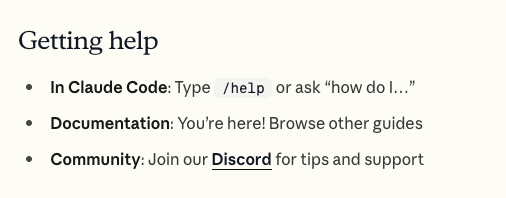
Getting help
* **In Claude Code**: Type `/help` or ask "how do I..."
* **Documentation**: You're here! Browse other guides
* **Community**: Join our [Discord](https://www.anthropic.com/discord)) for tips and support
#싸이트에 직접 들어가보세요. 표준전과 같은거에요.
#ClaudeCode #클로드코드 #Anthropic #AI코딩 #개발자도구 #터미널AI #CLI도구 #프로그래밍 #AI개발에이전트 #코딩생산성
'松泉, 바라보기, 인생글, 좋은글, 취미생활' 카테고리의 다른 글
| 뉴스, 요약, [🔴매봉쇼] "김민석 찍었나요?" 영등포구의원들 수상한 선거운동 (2) | 2026.08.04 |
|---|---|
| 뉴스, 요약, [12시에 만나요] 코스닥 3거래일 연속 매수 사이드카 발동…순환매의 시작일까? 부동산 세제 개편 발표!ㅣ2026년 8월 4일 화요일 (1) | 2026.08.04 |
| 뉴스, 요약, [정준희의 논] 작가 이완배를 묻다 마지막 인사, 마지막 질문ㅣ이완배 작가ㅣ2026년 8월 4일 화요일 (0) | 2026.08.04 |
| 뉴스, 요약, 김어준의 겸손은힘들다 뉴스공장 2026년 8월 4일 화요일 (1) | 2026.08.04 |
| 뉴스, 요약, 최욱의 매불쇼, 전당대회 유불리 분석! (리박스쿨에 침묵하는 민주당)|풀버전 (08.03) (1) | 2026.08.04 |


